
Do you want to change something in your life, but you feel stuck because there seem to be lots of barriers in the way? Do you know that it’s very common to feel emotionally and psychologically stuck at times in your life?
Why Feeling Stuck Is Not A Personal Failure
Change is inevitable in life. People expect change, but they don’t always want it, because it means leaving a comfort zone for something new. Change also needs time and the opportunity to adapt. Underpinning this is the belief that change can improve things, yet there is still resistance.
The problem is that resistance to change is often hidden and protective.
Feeling stuck in life is not being lazy or a lack of motivation and effort.
Change can challenge fundamental values and beliefs and threaten people’s sense of competence and confidence.
Change can become resistant when it continually challenges and opposes the change process.
Hypnotherapy can help you change. At Awaken the Change, I aim to help people move from the problem to the solution, and that means changing thoughts, feelings and behaviours. Wherever you are, online hypnotherapy or sometimes Hypnotherapy in Bournemouth, change is possible.
What “Feeling Stuck” Really Means
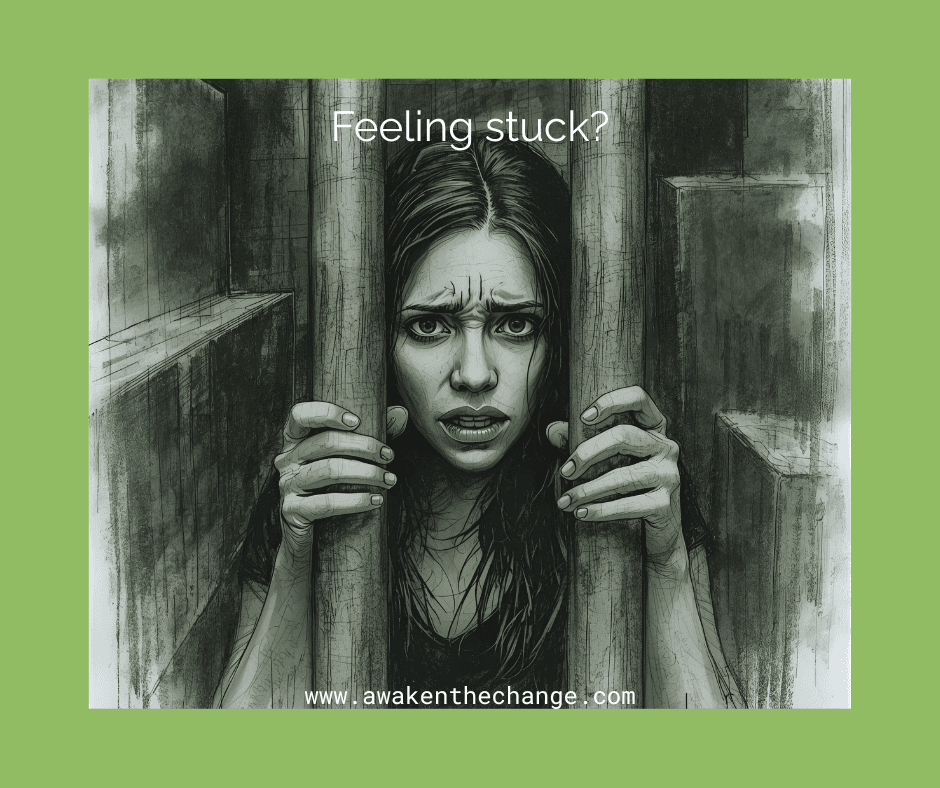
I’ve met so many people who have been stuck for a long time.
Let me give you some examples.
Some people want to stop smoking, but there is always a reason why it’s the wrong time, or they don’t feel that they are prepared. Maybe they are scared of stopping smoking.
They might get a lot of pressure from friends and family to quit smoking, but they resist. They know the reasons why they want to stop, for example, health or financial reasons, but they still don’t quit because it feels too hard.
They may also have been offered help from their doctor to quit, but they don’t accept it.
Let me offer a tip to stop smoking. Start to change the brand of cigarettes so the habit seems different. But will they do it? Probably not, because they need the whole package to reduce resistance and enable them to move forward in the change process.
Now, think of someone who lacks confidence to stand up and give a presentation at work. Perhaps they feel anxious, and their mouth dries up if they have tried to give a talk before. They know that they are unlikely to get a promotion if they can’t present to their team or customers. They won’t be able to earn more money without that promotion, and they won’t be able to increase the family income. They know what the problem is, and they want to change, but haven’t done so yet.
Let me offer a tip on the difficulty of public speaking. Deep breathing and speaking techniques can help people reduce anxiety around public speaking. But deep breathing and learning a few methods are still only part of a change process, and so they are unlikely to do it, and if they do, it won’t solve the problem completely. This gives them another reason to resist the change.
If I told you a technique to help you sort the problem, would you use it?
Probably not, because you would have already been told other techniques that haven’t helped. The solution is a whole-systems approach: change the resistance, focus on the real reason for change, and believe it will be easier than you think.
This can happen with counselling and hypnotherapy.
The Brain’s Role in Resistance to Change
The brain learns patterns through experiences delivered through our senses and body.
Our minds are programmed for survival and safety, so we prefer predictability to uncertainty. Familiar patterns, even those that keep us stuck, feel comfortable because the brain knows that change may carry risks.
New behaviours breed uncertainty.
Uncertainty activated the brain’s threat system.
This triggers the amygdala, the part of the brain involved in fear and stress responses.
This is not a conscious process; it happens automatically.
This is why just telling yourself to change doesn’t work.
Tiredness, too many demands on your time and stress all make the process of change harder.
.Hypnotherapy works by helping the brain feel safe enough to update old patterns. It supports relaxation, focus, and a shift out of threat mode. From this calmer state, the brain becomes more receptive to new learning, new responses, and healthier choices.
So now you have an idea of why change feels so hard.
Resistance is not your enemy.
It is a signal that your brain is trying to protect you.
7 Hidden Barriers that Keep You Stuck

There are several forms of resistance to change. They include:
- Low trust
- Prior change failure
- Unsure how to change
- Only understanding part of the change process
- Enjoying the comfort of the present by overvaluing what they have
- Too many choices
- Unrealistic about goals
- Fear of failure
- Fear of the unknown
- Worries about coping in a new way
- Not prioritising the change
Let me explain these barriers to change in more detail.
- Barrier 1. Fear of the Unknown. Many people fear the unknown because it might be worse than the present state, even though they don’t like the present state. The mind triggers uncertainty, and negative thoughts can make people worry about the future and risks. They can get stressed and anxious. This is where hypnotherapy can help, as hypnotherapy for anxiety is an effective treatment.
- Barrier 2. Fear of Failure or Fear of Success. These fears are at the ends of a continuum. People may want success, but the potential risks that come with it can be challenging to handle. A fear of failure is common, as previous attempts to deal with the problem may have failed, and the mind can remember that feeling—subconscious beliefs that shape behaviours. In these cases, hypnotherapy for confidence can help.
- Barrier 3. Identity and “This Is Just How I Am” Thinking. Difficulties with identity can lock people into emotional patterns of self-problematisation. We all need to think that we have the authority to change, but self-limiting beliefs get in the way.
- Barrier 4. Past Experiences and Conditioning. Our minds get conditioned by past experiences, trauma and loss. This sets up a protective system. Hypnotherapy can help to reframe negative experiences so that things can be seen from a different perspective.
- Barrier 5. Stress and an Overloaded Nervous System. Stress reduces our capacity to change. The ‘fight, flight, or freeze process takes over, and people get stuck. This means that they either run away from the change, resist it, or do nothing because they don’t know what to do next.
- Barrier 6. Overthinking and Mental Control. Overthinking and analysing are common resistances to change. Hypnotherapy helps to quieten the mind and body.
- Barrier 7. Protecting Yourself From Emotional Pain. Resistance acts as a self-protection. People don’t try to change because they don’t want to feel disappointed or vulnerable if they fail.
Why Willpower Alone Rarely Works
Willpower comes from the conscious mind. What is needed is a change in mental patterns originating in the subconscious mind.
Hypnotherapy is a complementary therapy that supports change; it’s not magic.
How Hypnotherapy Helps You Change Gently and Safely
Hypnotherapy helps you refocus on what you want rather than what you don’t.
It helps you take back control.
Many people feel mentally and physically relaxed, so they feel more able to make changes.
No one knows exactly how hypnosis works, but it is believed that through positive suggestions and visualisations, people change their neural pathways.
Are You Ready for Change?
So if you feel stuck and need help, are you ready for change now?
Hypnotherapy could be your solution.
Contact me to find out more and book a complimentary consultation.